Smart

Interview with Councillor Mattia Morolli on Rimini’s environmental projects

Clip of Coesion #78 – On 18 May we were at the EYE Forlì event with many activities organised and implemented by the Eu Factor Next team focused on the needs of young people and their role in the upcoming European elections!

Over the decades, our society has taken a huge jump forward in terms of technological breakthroughs. These have indeed made our lives easier, but at a very high cost. In many metropolises, the pollution rate reaches alarming levels, despite the various renewable and e-green energy sources.

And it is precisely from this premise that the project for the new episode of the ‘EU with YOU’ podcast started. The project aims to revolutionise the world of renewable energy through a biological methanator, i.e. a reactor that is able to store renewable energy. The methanator uses carbon dioxide and hydrogen to produce energy. How?
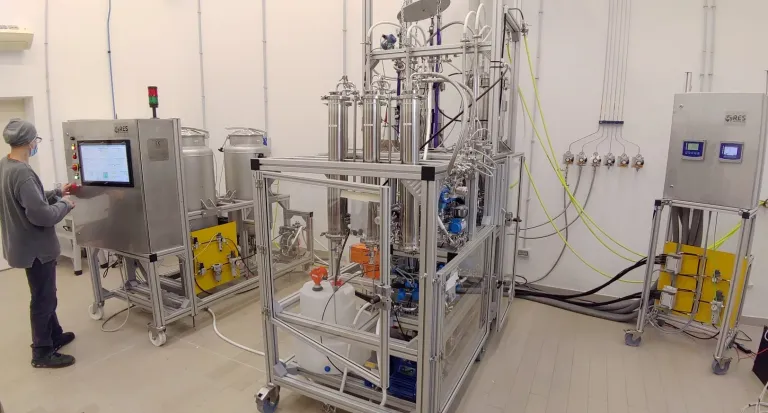
Inside the reactor, CO2 and hydrogen are converted into gas (methane) through a process using electricity. In fact, methane, unlike renewable energy sources, can be stored inside batteries and used in the future. This is the main difference with the rest of the e-green projects: Co2 batteries, on the other hand, can utilise both industrial and natural carbon dioxide, thus allowing for greater availability.

The construction of the ‘biological methanator’ saw the coming together of several companies that collaborated to realise the project. The startup Energy Dome, born in 2020 in Milan, specialised in renewable energy and creator of the project. Res Italia (Reliable Environmental Solutions), a Ravenna-based company specialising in the creation of specific systems for renewable energy production. RES Italia worked side by side with Agenzia Sardegna Ricerche, based in Cagliari, where the methanator is located.

Find out more about this green project by listening to the “EU with YOU” podcast: https://podcast.areanews24.it/podcast/areanews-eufactor.htm

“EU with YOU” is the Eu Factor Next podcast realised by Raduni, the Association of Italian University Radio Operators, to tell citizens at first hand how European funding is spent. In each episode the podcast will tell the story of a project funded by the European Union and its Cohesion Policy on the national territory.

The FRU in Rome with Raduni, partner of Eu Factor Next

Clip of Cohesion #77 – We participated in FRU, a national event organised by Raduni at La Sapienza University in Rome. Thanks also to Europhonica, a web radio dedicated to Europe, we were featured on their podcast

The CER, not just an infrastructure but a place of experimentation open to all

Digital Revolution in Apulia: an ambitious integrated project to optimise Environment, Agriculture and Regional Services

The main objective of the project ‘Puglia Digitale – Operational Plan Ecosystem Agricolture Territory and Environment’ is to strengthen and evolve the system of data and services of the infrastructures of the territory. In order to achieve this goal, however, a multiplicity of sub-interventions or sub-projects are required, such as the experimentation of new technologies for better knowledge of the territory.

Through these technologies, one can also:

  • analyse how the territory and the dynamics within it are evolving and quickly predict events or interventions by analysing past data,
  • update maps, making them always up-to-date,
  • update data in archives from paper to digital,
  • create new digital systems and services for citizens, authorities, the region and other actors to better monitor requests and interventions.

The implementing company of this project is InnovaPuglia. However, intervening at the regional level, they received support both from the region itself and from various sectoral and transversal bodies. Among these, a particularly fundamental role is played by the RTD (Responsible for Digital Transition).

The project implementation is currently still ongoing. Most of the funds for project implementation come from the European Commission’s 2014-2019 Cohesion and Development Fund, which is the institution in charge of such funding.

Find out more about the Puglia Digitale project by listening to the ‘EU with YOU’ podcast: https://podcast.areanews24.it/podcast/areanews-eufactor.htm

‘EU with YOU’ is the Eu Factor Next podcast realised by Raduni, the Association of Italian University Radio Operators, to tell citizens at first hand how European funds are spent. In each episode the podcast will tell the story of a project funded by the European Union and its Cohesion Policy on the national territory.

The DIAST Project ‘Development of a Diagnostic System for Space and Earth Applications‘ was set up in the Region of Tuscany and is the result of the commitment and union of numerous local organisations and companies, which are benchmarks in the space sector and for industry and research. 

Underlying the project is the desire to transform traditional forms of propulsion. In fact, from traditional chemical propulsion, electric solutions were sought to ensure not only greater efficiency and flexibility, but also to release more power, from 1.3 kW to 5 kW.

In order to be able to realise such engines, however, it was necessary to create a test bench suitable for supporting these new technologies. This state-of-the-art diagnostic system, unique in Europe, revolutionised and deepened the analysis of high-power thrusters. This test system is essential for manufacturers of satellite platforms and other space components, and these new technologies may also have other uses in the future, such as in the environmental field.

The DIAST Project was activated in 2016 and finished in 2018, half of which was financed by the Cohesion and Development Fund, belonging to the 2014-2020 Cohesion and Action Plan (CAP), while the remaining half came from the Region of Tuscany.

Find out more about the DIAST project by listening to the ‘EU with YOU’ podcast: https://podcast.areanews24.it/podcast/areanews-eufactor.htm 

‘EU with YOU’ is the Eu Factor Next podcast realised by Raduni, the Association of Italian University Radio Operators, to tell citizens at first hand how European funding is spent. In each episode the podcast will tell the story of a project funded by the European Union and its Cohesion Policy on the national territory.

Clip of Cohesion #73 – Are young people ready and prepared to vote in the upcoming European elections? We also discover the Imola-based cooperative Hibou, which works with Europe on a daily basis

Clip of Cohesion #72 – The European Parliament approved the directive to increase energy performance in buildings by reducing greenhouse gas emissions in the sector by 2030 and to achieve climate neutrality by 2050